The left-field approach taken by Team Ninja has created the most intriguing combination of action, story and mystique on the Wii thus far. Other M, set after Super Metroid, follows bounty hunter Samus Aran as she receives a distress call for help, following her confrontation with Mother Brain which wiped out the Metroid species. She follows the distress call to an abandoned space vessel known as the ‘Bottle Ship’. On the Bottle Ship, she encounters her former Galactic Federation colleagues conducting an investigation. The succeeding events play out in a presentation very similar to the Metal Gear Solid series, the story being told in lengthy cut-scenes dispersed throughout the game.
The first half hour of gameplay leaves a bitter taste in the mouth, as very little action takes place in amongst the dialogue-driven storytelling, and the first chance to use the Wii Remote control scheme doesn’t make a good first impression. Using the control pad to move around in a 3D area feels clumsy at first, and the notion of pointing at the screen to go into a 1st person view seems questionable during the opening action sequences of the game. Fortunately, the controls quickly become second nature, and the action to story ratio becomes more balanced.

All of the action feels like the Metroid games of old, but with a new twist, giving the player a satisfying mix of exploration (which there is no lack of) and space creature combat. Samus has retained all of her abilities from the previous games, although they are unlocked progressively when the need to use them arises. Fighting the many different enemies that Samus comes across is where the control system finally finds its feet. A quick tap of the control pad as an enemy attacks, dodges the imminent danger in a matrix-like fashion, allowing the bounty hunter to unleash a devastating counterattack upon the hapless foe. These counterattacks reward the player with an instantly charged beam, which can be implemented by jumping on top of the enemy and performing an execution-style finisher. These finishing moves really invigorate the senses; the game camera zooms in upon commencement of the move, giving the fight a cinematic feel, and then quickly zooms out ready for the onslaught of additional enemies.
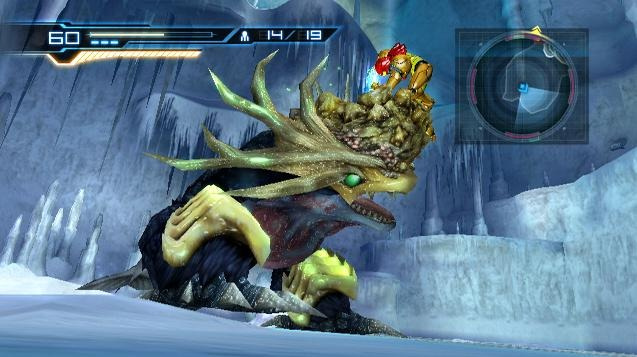
The depth of the combat system isn’t best showcased until one of the many boss fights starts. The player has to use not only reflexes and quick shooting, but strategy also needs to be implemented in order to be successful. Often, many games are guilty of creating a boss fight that can be surpassed by a quick trigger-finger. The bosses in Other M are totally unique, all employing a different set of tactics to destroy Samus. For example, one boss can crawl all over the walls and ceiling of an abandoned laboratory, while using a heavy-gravity machine to render Samus’ dodge move useless. This fight in particular requires the player to think in advance what combination of moves would be most effective against such a foe. Other M excels during these boss fights, the design of the enemy, its attacks, and the surrounding environments all add up to create the trademark Metroid moody atmosphere, giving the ‘In space, no one can hear you scream’ feeling. It all just makes finally beating that boss so much sweeter.

Although the entire game is set on the Bottle Ship, where research is undertaken, the many areas of the game are quite varied, thanks to the ship containing many holographic devices that simulate a range of different habitats and weather conditions. These places are fleshed out quite nicely, and look reasonably realistic. It’s obvious that the design team put a fair amount of work into designing the characters and locations, and the results look great. Although every area that Samus traverses has a fixed camera angle, it doesn’t impede on the gameplay at all, only becoming a nuisance when the player needs to backtrack for whatever reason and can’t see any enemies coming from behind.
The story itself is aimed mainly at fans of the Metroid series, looking for a back-story on Samus’ life. She provides a lot of monologues on what is going on and how it relates to her past, but more often than not it shows a more emotional and reflective side of Samus that feels a bit hit-and-miss. That of course depends on how much the player actually cares why she gives a thumbs-down to her former commander, or why she empathises with (insert generic scientist’s name here). The good thing though, is that the voice acting is top-notch, giving each character, well, a sense of character that gives the player a reason to care about their actions. Sometimes the story and acting can be a tad melodramatic, but that’s to be expected from an anime-style game.
The Metroid series has been heavily based on exploration and item collecting; Other M still retains these traits to an extent, but not to the degree of the previous titles. Gone now are the pickups for health and missile regeneration from fallen enemies, but in its place there is a new mechanic that allows the player to hold the Wii Remote vertically and charge up a small portion of health or fully replenish the missile stocks. Some might argue that this makes the game easier, however only a pittance of health can be restored, and only once Samus’ health has fallen below a set threshold, also trying to regenerate missiles during a massive fight is not easy. Scattered throughout the Bottle Ship are plenty of upgrades that boost the amount of health and missiles, or quicken regeneration time, and these items can require some clever puzzle navigating to obtain. These items aren’t just beneficial for progress, but they provide a pleasant distraction from obliterating monsters and watching cut-scenes.
Unfortunately, the thrilling atmosphere of Metroid Other M doesn’t last for very long. The whole story can be played through quickly in less than 10 hours, although collecting all of the pickups provides an incentive to continue playing.
Other M provides an experience unlike any other game on the Wii, filled to the brim with action, tense moments, and a dramatic story combine to continue the Metroid series in an exciting, atmospheric manner. Setting aside a short play-time, and a hit-and-miss story, there is more than enough action to make Other M a 10+ hours well spent.